Back to Full Frame
After years immersed in the Olympus Micro Four Thirds world, I’ve come full circle. I’m back on full-frame Sony, and it feels right.
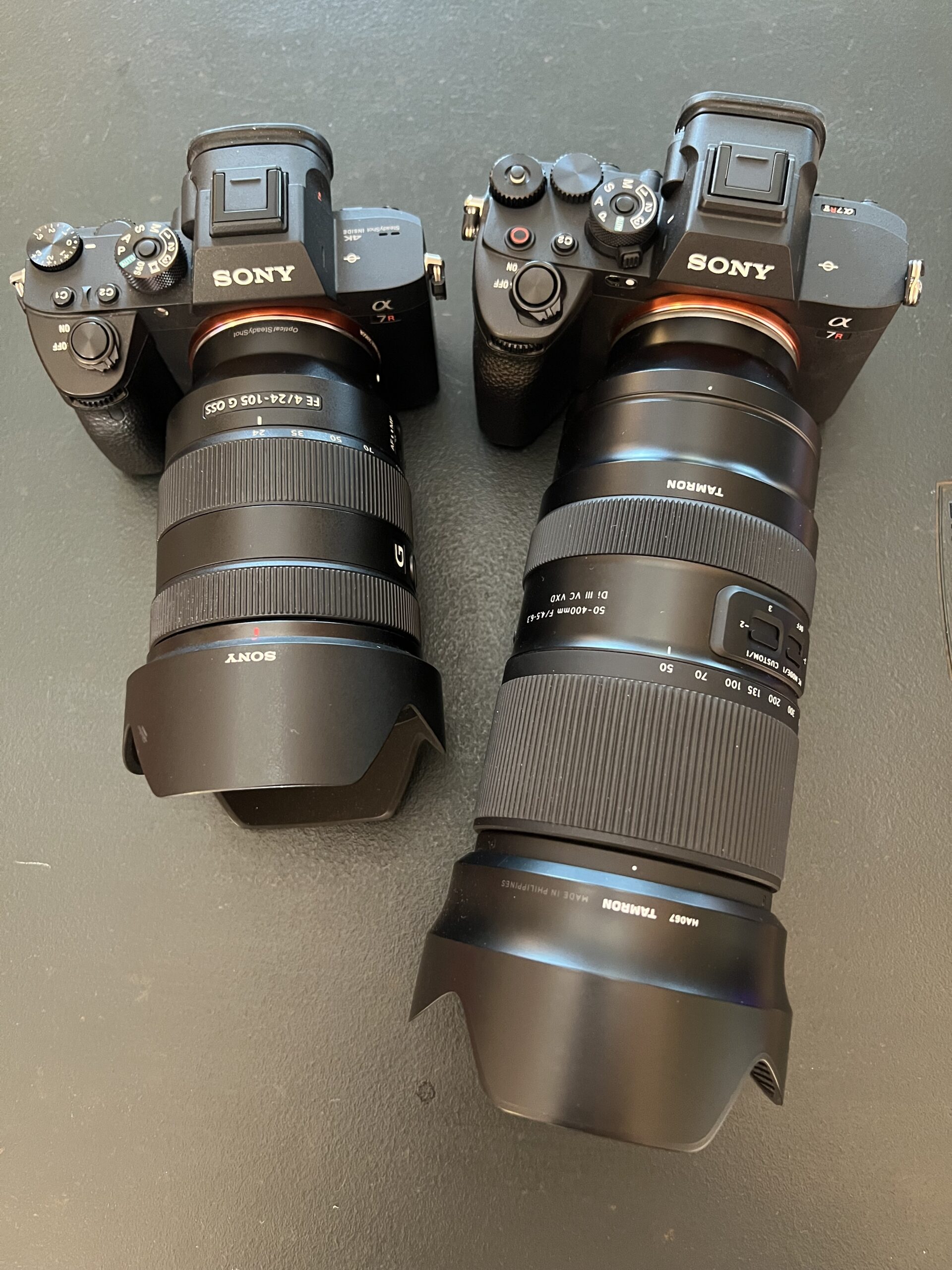
The new full frame cameras I use every day
Don’t get me wrong—I haven’t abandoned the smaller system. My Olympus OM-1 paired with the 12-200mm still travels with me. It’s been through Japan and Europe, and for those trips it’s ideal. The combination is versatile, light, and easy to carry through airports without the burden of heavy kit. The OM-1 itself is a clear step up in image quality from earlier generations, and its AI bird detection is something I rely on heavily for wildlife. It remains a fantastic tool when portability and flexibility matter most.
But for everyday work at home, for walking around, and for the images I care about most as art, the full-frame look of Sony simply can’t be surpassed. I’m not ashamed to admit I pixel-peep. The richer detail, the smoother tonal transitions, the way the background falls away—it’s a different rendering, and it’s the one I prefer.
The camera that brought me back is the Sony A7RV. It packs a 61-megapixel full-frame back-illuminated Exmor R CMOS sensor, the powerful BIONZ XR processor, and a dedicated AI processing unit. Real-time Recognition AF covers humans, animals, birds, insects, cars, trains and planes with impressive accuracy. It offers up to 8 stops of in-body stabilisation, 10 fps continuous shooting with AF/AE tracking, a high-resolution 9.44-million-dot electronic viewfinder, and a fully articulating multi-angle screen. 8K video capability is there if I ever need it. It was an expensive purchase here in Australia, but I genuinely feel this body will serve me for years. I don’t see myself needing to upgrade again anytime soon.
Nature and birding are my main subjects. For a long time my favourite combination was the Olympus 300mm f/4 IS PRO. That lens is pure robust quality—sharp, well-built, and with excellent stabilisation when paired with an OM body. It’s hard to see how anything could meaningfully surpass it in pure optical performance for a 600mm-equivalent prime.
Yet the lens that now lives on my A7RV most of the time is the Tamron 50-400mm f/4.5-6.3 Di III VC VXD. I’ve grown to love it even more than the Olympus 300mm, and the reasons are practical. It’s a zoom. It starts at a usable 50mm, so in a pinch I can shoot street or general scenes without changing lenses. Then it reaches all the way to 400mm when a bird appears or I need to get closer. That 8× range is extraordinarily useful. Build quality is solid, weather-sealed, and the sharpness across the zoom range has impressed me. Vibration Compensation works well, the VXD linear motor focuses quickly and quietly, and the close-focusing capability (half-life-size at the wide end) adds another dimension. Because the A7RV also has excellent AI bird detection, the combination feels complete. The Tamron stays mounted most of the time.
My older Sony A7RIII usually carries the Sony FE 24-105mm f/4 G OSS. It’s a superb walkabout lens—constant aperture, optical stabilisation, excellent sharpness, and a very practical range from wide to short telephoto.
Forget the old “holy trinity” approach I once considered with Nikon. I simply don’t need it. Two lenses cover almost everything I do: the Tamron 50-400mm on the A7RV for nature, birds, and flexible everyday shooting, and the 24-105mm on the A7RIII for walking around and general work. The OM-1 with 12-200mm still fills the travel and ultra-portable role when required.
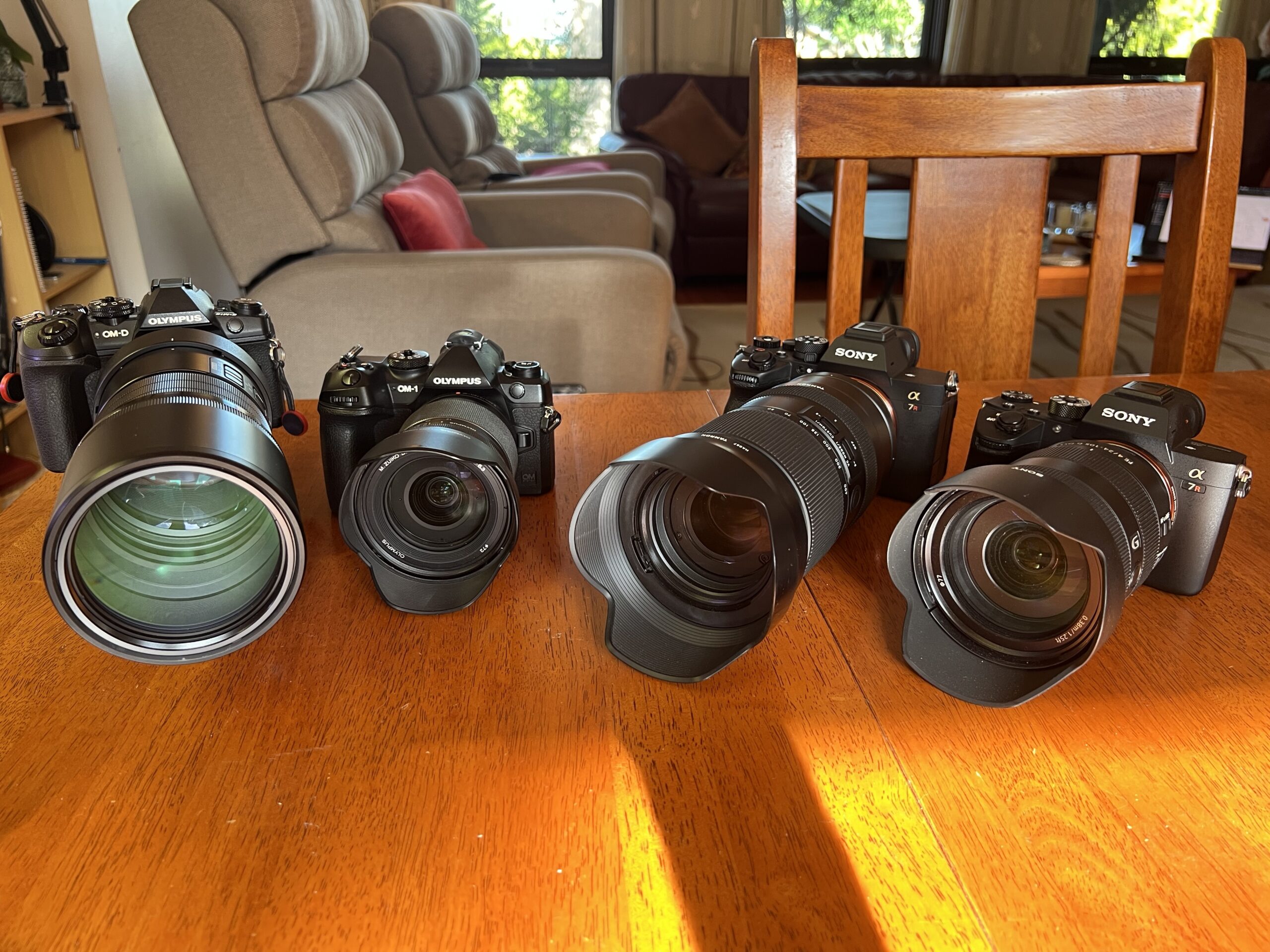
The old micro-four-thirds cameras on the left, the new full-frame cameras on the right
Coming back to full frame wasn’t about chasing the latest gear for its own sake. It was about rediscovering the look and the creative freedom that made me fall in love with photography in the first place—while still keeping the practical advantages of Micro Four Thirds when travel demands it. The A7RV and that Tamron zoom have made the transition feel seamless. For the first time in a long while, my kit feels settled.